
Key capabilities
- Multi-step pipeline builder with LLM generation, tool calls, conditionals, and branching
- Batch execution across accounts
- Context recipes for reusable research configurations
- Frameworks for reusable workflow templates
- Workflow history and tracking
- Model selection per step - choose the right LLM for each task
Who it’s for
When to use workflows vs. the Agent
Rule of thumb: If you’ll do the same task more than 3 times, build a workflow. If it’s a one-off exploration, use the agent.
Effective workflow patterns
Meeting preparation pipeline
1
Pull account data
Pull strategic priorities and recent news (tool call)
2
Identify attendees
Identify meeting attendees from contacts (tool call)
3
Generate talking points
Generate talking points aligned to company goals (LLM generation)
4
Draft discovery questions
Draft discovery questions based on account context (LLM generation)
5
Produce meeting brief
Compile a one-page meeting brief (LLM generation)
Territory health review
1
Check for changes
For each account in segment: check for Intelligence changes since last review (tool call)
2
Flag accounts
Flag accounts with significant changes (conditional)
3
Generate summaries
Generate a change summary for flagged accounts (LLM generation)
4
Compile report
Compile a territory health report (LLM generation)
Account research and engagement plan
1
Run Intelligence review
Run comprehensive Intelligence review (tool call)
2
Identify competitive landscape
Identify competitive landscape (tool call + LLM generation)
3
Map stakeholders
Map stakeholders and recommend contacts (LLM generation)
4
Generate value alignment
Generate value alignment analysis (LLM generation)
5
Draft engagement plan
Draft engagement plan with recommended sequence (LLM generation)
6
Generate outreach emails
Generate 3 personalised outreach emails (LLM generation)
Tips for effective workflows
1
Start with pre-built workflows
Run them as-is to understand the pattern, then customise.
2
Use context recipes
Don’t reinvent how Intelligence data is gathered for each workflow. Recipes standardise this.
3
Test on a small sample first
Before running a workflow across 200 accounts, validate the output on 3–5 accounts.
4
Review output quality
Workflows produce consistent output, but consistency doesn’t guarantee quality. Review and iterate.
5
Chain workflows
A territory review workflow can identify accounts that need attention; an engagement plan workflow can generate plans for those accounts.
Monitoring and troubleshooting
- Workflow history shows the status of every run: completed, failed, or in progress.
- Step-level detail shows which step failed and why.
- Retry is available for failed runs.
- Output inspection shows the generated content at each step.
Related modules
Agent
Use the agent for one-off research and exploration before building repeatable workflows.
Canvas
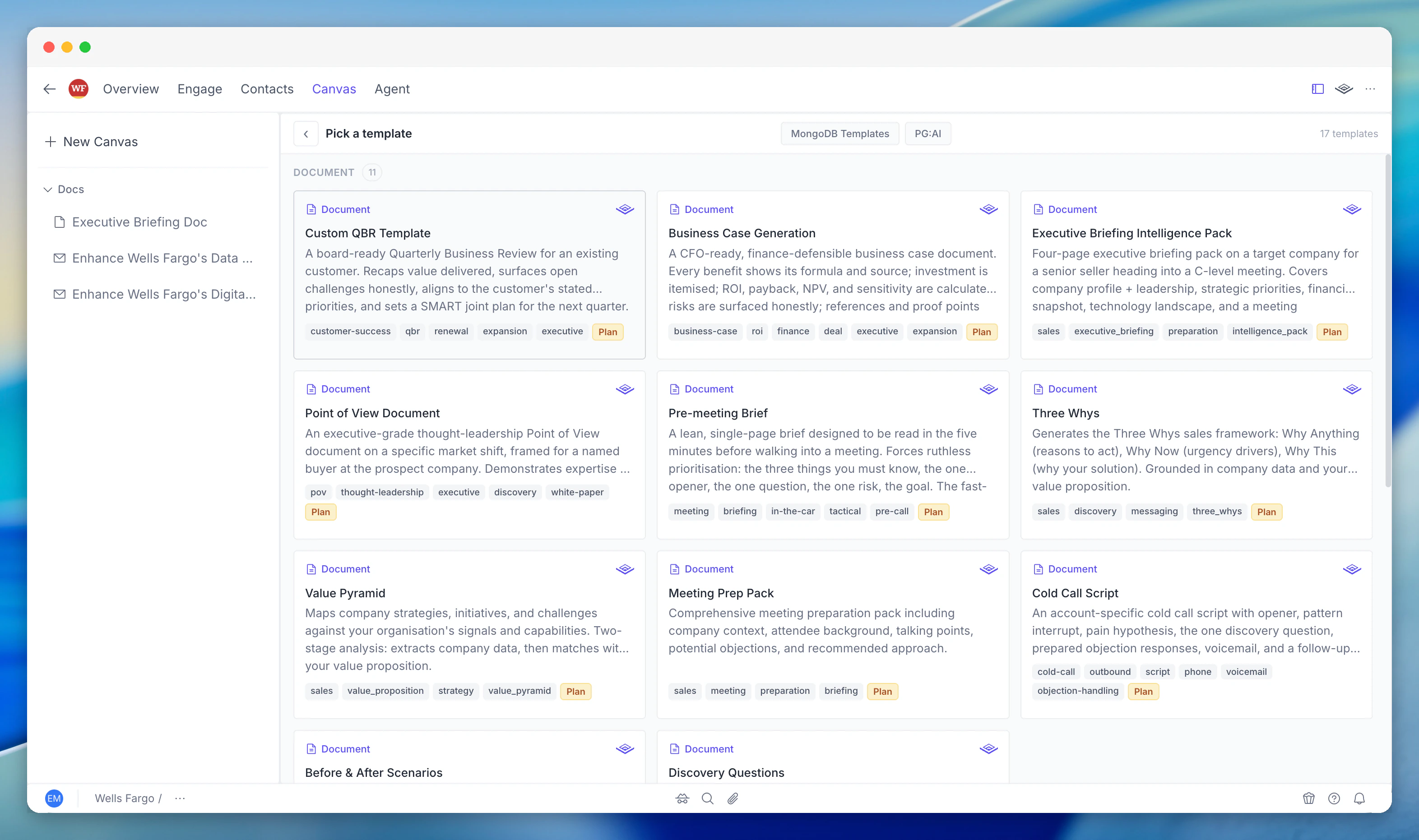
Workflows can generate Canvas documents as output for individual accounts.
StudioMail
Include email context in workflow steps for more personalised content generation.